Why 1:1 Support Matters in Perimenopause Through Post-Menopause

By Yarrow Method | Certified Hormone Health Coach, Holistic Nutrition Coach, Herbalist & Member of The Menopause Society
There is a real limit to what a blog post, a symptom checklist, or even a comprehensive guide can do for you.
Not because the information in them isn't accurate or useful — it is. But because your body, your history, your specific combination of symptoms, and the reality of your daily life are yours alone. General information can tell you what's true for most women navigating perimenopause. It cannot tell you what's true for you, specifically, right now.
That gap is exactly where 1:1 support earns its place.
Why general information has a ceiling
Educational content — including everything on this site — is built to address patterns that apply broadly. When we write about blood sugar's role in perimenopausal brain fog, or the mechanism behind 3am waking, we're describing something that holds true for a large percentage of women experiencing those symptoms.
But you are not "a large percentage of women." You are one woman with a specific menstrual history, a specific stress load, specific foods you already eat and dislike, specific medications that may interact with certain herbs, and a specific symptom pattern that may not match any single article precisely.
A guide can tell you that protein at breakfast supports blood sugar stability. It cannot tell you what that looks like given your food preferences, your morning schedule, your digestive sensitivities, or the fact that you've already tried three things that didn't work and need to understand why.
This isn't a criticism of educational content — it's simply an honest acknowledgment of what it's built to do and where its usefulness reaches a natural edge.
What 1:1 support actually changes
It replaces guessing with a specific plan. Reading that magnesium, protein, and passionflower support sleep is useful. Being asked directly what you've already tried, why it may not have worked for your specific pattern, and what to try instead in a sequence built for you — that's a different order of usefulness entirely.
It catches what general content can't. A written guide can't know that you're on a blood thinner and shouldn't combine it with certain herbs without medical guidance. It can't know that your "can't sleep" is actually "wake at 3am with a racing heart" rather than "can't fall asleep at all" — a distinction that changes which intervention matters most. A conversation catches these details. A checklist alone often doesn't.
It shortens the time between symptom and relief. Many women spend months or years trying things somewhat randomly — a supplement a friend recommended, an article's suggestion, a partial change abandoned before it had time to work. A focused conversation that identifies your specific root drivers and gives you a clear starting sequence can meaningfully shorten that trial-and-error period.
It provides accountability and clarity in a way that reading alone doesn't. There's a meaningful difference between knowing you should eat more protein and having explicitly said out loud, to another person, "this week I'm going to have eggs and yogurt for breakfast." Speaking a plan aloud and having it reflected back to you in writing afterward tends to produce real follow-through in a way that passive reading rarely does.
Why this matters more in perimenopause specifically
Perimenopause is a uniquely disorienting transition for a specific reason: it doesn't present the same way twice, even within the same woman. Symptoms shift. What worked for a few months may stop working. New symptoms emerge as hormones continue to fluctuate. This is not a static condition with a fixed protocol — it is a multi-year process that often requires recalibration along the way.
That reality makes ongoing, personalized guidance more valuable here than it might be for a more static health concern. A woman navigating early perimenopause with irregular cycles and worsening PMS has meaningfully different needs than a woman two years post-menopause dealing with persistent hot flashes and bone density concerns — even though both fall under the broad umbrella of "menopausal symptoms," and even though a lot of general content addresses both together.
Add to this the well-documented reality that most healthcare providers — including many OB/GYNs — receive minimal formal training specifically in perimenopause and menopause management. Multiple studies have found that a significant majority of OB/GYN residents do not feel adequately prepared to manage menopause care, and a substantial share of residency programs lack dedicated menopause curricula entirely. This is not a criticism of individual providers; it reflects a genuine gap in how menopause has historically been prioritized in medical education. It also means that for many women, the informed, personalized guidance they're looking for isn't reliably available through standard medical care alone — which is precisely the gap that credentialed, hormone-specific 1:1 support is positioned to fill.
What personalized support looks like in practice
Effective 1:1 support for perimenopause typically involves several things that general content structurally cannot provide:
A thorough understanding of your specific history — not just your current symptoms, but your menstrual history, medication and supplement list, sleep patterns, stress load, and what you've already tried.
A conversation where you can ask the questions that don't fit neatly into a blog post — the "but what about my specific situation" questions that are often the most important ones.
A written plan built around your actual life — not a generic protocol, but one that accounts for your food preferences, your schedule constraints, and what's realistically sustainable for you this week, not in an idealized version of your life.
Clarity on what to prioritize first when multiple things feel like they need attention simultaneously — because trying to change everything at once is a common reason good intentions don't translate into lasting change.
You don't have to figure this out entirely on your own
If you've read through the educational content on this site and found yourself thinking "this is helpful, but I still don't know exactly what to do about my specific situation" — that reaction is not a failure of the content or a failure on your part. It's simply the natural edge of what general information can offer, and it's exactly the gap 1:1 support is designed to close.
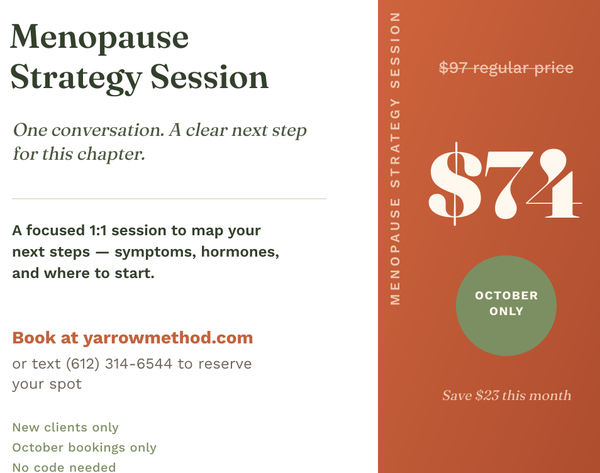
A Yarrow Method Strategy Session is built around this specific need: a focused 30-minute conversation, informed by a detailed intake covering your history and current symptoms, followed by a customized written protocol delivered within 24 hours — covering the nutrition, herbal, and lifestyle recommendations built specifically around what you're experiencing right now.
You don't need to have this all figured out before reaching out. That's precisely what the session is for.
Ready for guidance built around your specific situation? Learn more about Yarrow Method Strategy Sessions and book a time that works for you.
→ Book your Strategy Session with Yarrow Method
Not ready for a 1:1 session yet? Start with our free Perimenopause Symptom Guide to begin understanding your own patterns.
→ Start with the free symptom guide to map your specific symptom picture